A life behind the lens: “Paul Bernardo was just a foot away from my camera”

K.D., 61

My Life in a Nutshell:

  • I care more about friends as I get older
  • I wish people cared more about their health
  • A significant hardship I’ve endured is being away from family
  • I’m the fifth of nine children, but never had any children of my own
  • I have been a cameraman for nearly 40 years and have covered stories all around the world
  • My career has been important to me and I take pride in my work
  • It bothers me if I get a feeling my work or effort isn’t being appreciated
  • I sometimes wonder if I should ever have moved to Toronto
  • I wish people would look at me and think: “This guy has his shit together”
  • I am “half and half” on a happiness scale
  • I’m a sociable guy, but I don’t get out enough

K.D.’s story

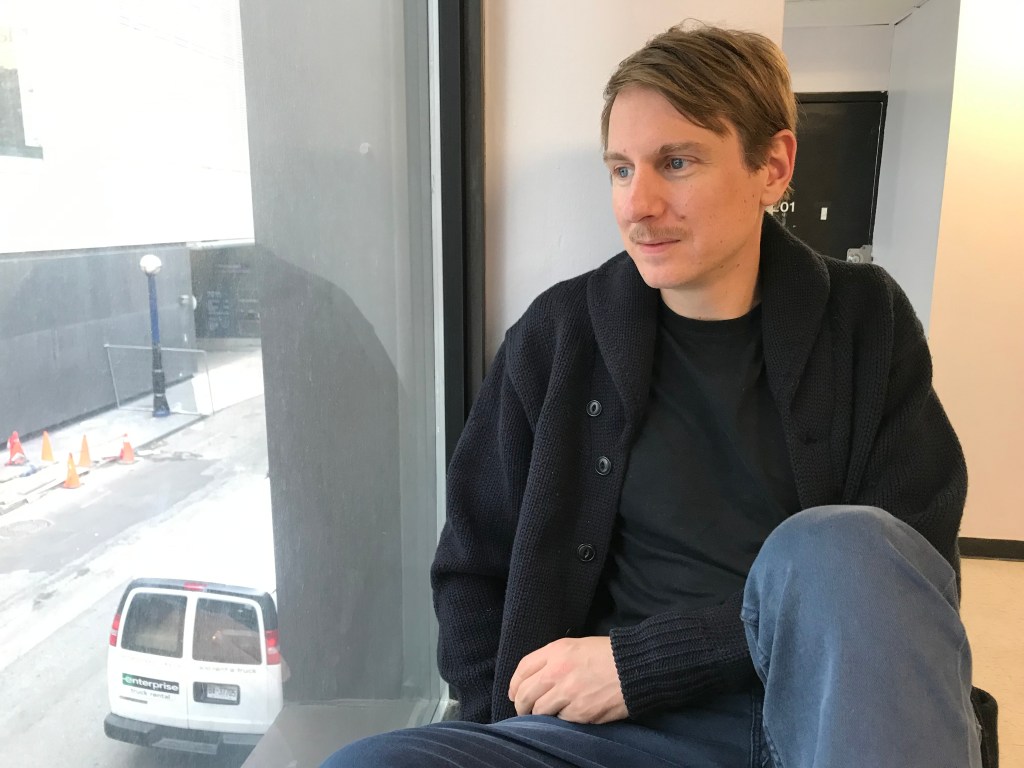
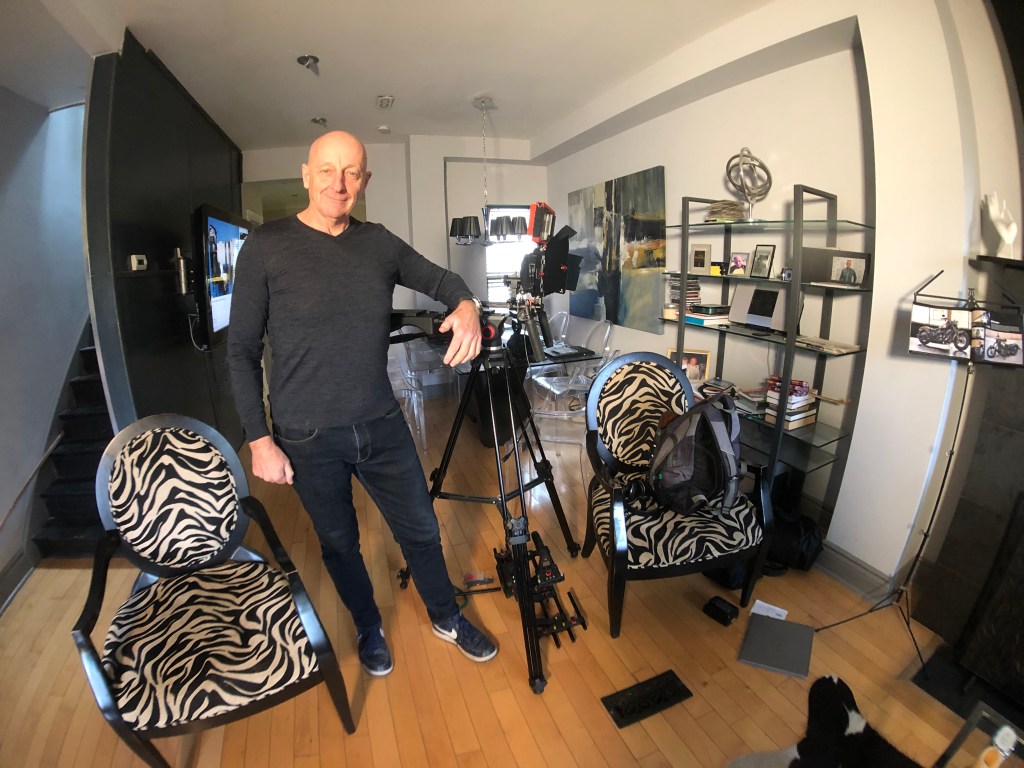
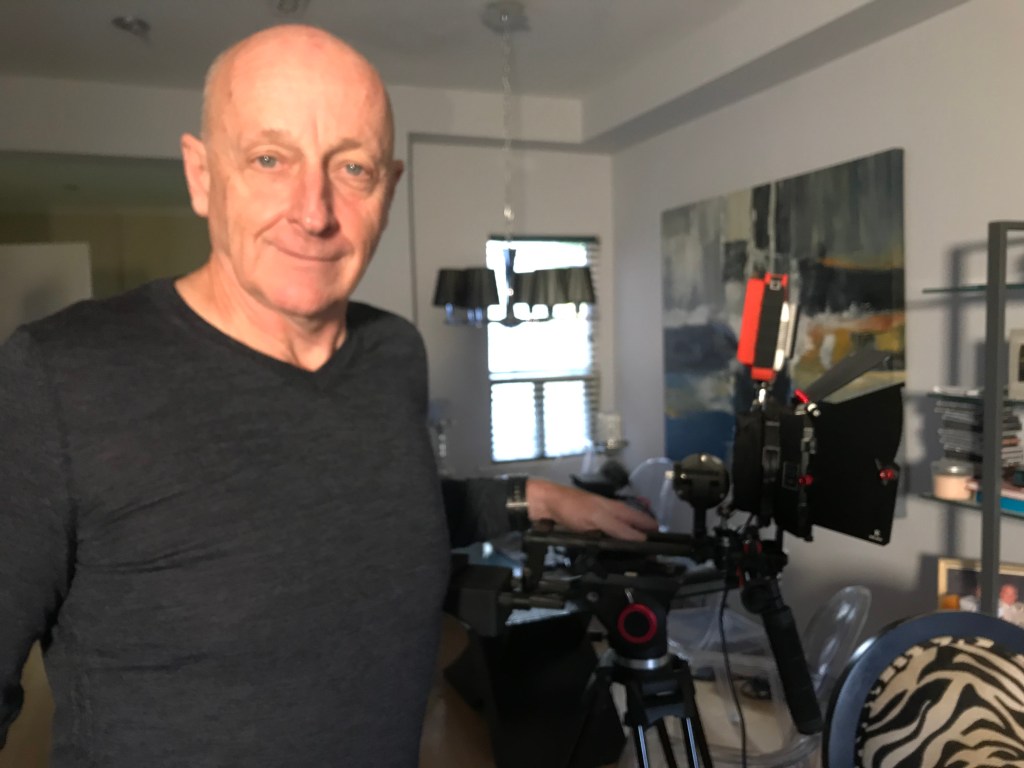
When I walk into K.D.’s home, a handsomely decorated semi-detached near Casa Loma, dozens of pieces of state-of-the-art camera equipment are strewn across his living room.  The 61-year-old is a veteran news cameraman, but he’s a newly minted freelancer.

“I don’t really have to work, so I’m not nervous.  But it’s a learning curve, going from a $50,000 to an $11,000 camera — it’s a learning curve.  They’re finicky.”

For 37 years, K.D. worked at one of Canada’s leading broadcasters.  In a recent round of cutbacks, however, the senior shooter accepted a package he couldn’t refuse.  

“It was a perfect time to leave.”

It wasn’t, however, a perfect time to retire.

“I don’t like that word,” he says.  “I’ve had a decent life and there’s still lots left.  I don’t think of myself as old.  I don’t want to get into that mindset.”

So now K.D. is starting over, picking up equipment and jobs where he can.  

“You know, I did a shoot with a former colleague recently and got paid quite a bit of money, so I hired an editor to come to my house.  We had bagels and coffee.  It was stress-free.  It was fun, so it was a good experience.”

It is a stark juxtaposition to the way K.D. started out in the business. 

“My first year I was so nervous, and I was driving what looked, essentially, like an old police car, and I almost hit a hydrant.  I ended up scraping the side and the back accidentally, and I was so nervous about losing my job I took it to an auto body shop and paid to have it repaired,” he says with a laugh.

K.D. was just 26-years-old when he began working in Toronto, Canada’s largest city.

“It was tough, very tough.”  

In fact, he says, in some ways camera work was the last thing on his mind when he was a “greenhorn.”

“There’s a lot of things you have to learn about this job.  Where to park, dealing with people, going to shooting scenes, wondering if you’re going to get shot, pushing the envelope with the cops to get the shot.”

But the nerve-wracking first years aside, K.D. went on to have an illustrious career, covering major news stories both at home and abroad.

“Because of my ability, people loved to work with me.  It gave me a good feeling that people had confidence in me, so I excelled at my work.  Work was probably pretty important to me because I didn’t have a family.”

K.D. has seen plenty of danger.  He spent a month covering the Gulf War.

“We weren’t sleeping, alarms were going off.  We’d get up to work all day and we’d get up in the middle of the night because planes would take off, the hotel would shake.  Scuds would come by fairly close, so we’d try to get shots.”

He’s also met some of the most dangerous human beings on the planet.

“Paul Bernardo was just a foot away from my camera.  I couldn’t believe how close he was.  I could have slugged him,“ he says of the moment he shot the notorious serial killer.  

“I looked him in the eye — he was about the same height.  I wanted to see if I could see the evil in him.  And I couldn’t see anything.”

K.D. has also met some of the most famous A-Listers in the world.

“Nicole Kidman just left a good impression.  We got her coming into the Princess of Wales Theatre, but she was coming by during the commercial break.  But she stayed and waited and we did our live with her. It’s amazing how some stars are just so accommodating.”

The ever-stylish cameraman, who has a penchant for Hugo Boss, has come a long way from his roots.  Not only is he 170 kilometres from his hometown, but as the fifth child of nine, he wore nothing but hand-me-downs as a child.

“When I was a little guy we’d get new underwear and socks, but when it came to pants and shirts, we’d open up the big red box in the basement and reach in and find something that fit us,” he recalls.  “Most of the time, they didn’t fit.  One time I remember pulling out a pair of green bell bottoms and they didn’t fit, but I wore them anyway,” he says.

Still, he says, given his “old-fashioned” upbringing, fashion didn’t matter to him.  As a youngster, his priorities were quite different.

“Just going to the river fishing, swimming in the river, staying there all day.  Making go-karts, climbing trees, the skating rink in the backyard, always being active.  It was great growing up.”

K.D.’s father worked on trains for the Canadian National Railway.

“All he did was work and bring money home.  We didn’t have much money, but we never starved. Although, with nine kids, you didn’t eat as much,” he says.  “The big thing was Kentucky Fried chicken.  If we had a bucket — boy, that was a big thing.”

While his father was laid back, he says his mother was the disciplinarian.   

“You didn’t want to be caught doing something.  She’d drive around with a wooden spoon looking for me and I’d be hiding in a bush,” he laughs.

He says, over the years, he has often wondered if he made the right decision in moving to Toronto. 

“Because as you get older — both of my parents are dead, and I didn’t see them much in my latter years.  It would have been a different path.”

In fact, he says, the biggest hardship he’s had to endure is being away from family.

“I can’t call up my sisters.  If they were here, I could call them and say, ‘Hey, let’s go to a restaurant.’  I don’t have that luxury where I can call any of them and say, ‘Let’s go out tonight.’  I’m sure a lot of people live with it; but, you know, your life is much more full when you have family around.”

That being said, K.D. admits life in London, Ontario would not have suited him.  He’s used to the fast pace of a big city and its restaurants and culture.

“When I drive my motorcycle North, it takes forever to get out of Toronto.  And when I get out to the suburbs, I think to myself, ‘I couldn’t live there, because it’s so far from everything.’ I have a subway right near.  I can walk to Yorkville in 12 minutes.”

At this point in his life, K.D. says he is fairly happy and enthusiastic about life, although at points he struggles with loneliness. 

“I don’t do well by myself all the time.”

That is why friendship is increasingly important to him. 

“I care more about friends as I get older, and making an effort at staying in touch.  I lost touch with a lot of people over the years.”

K.D. has had long-term girlfriends, but none of his relationships have ever stood the test of time.  He has no children.

“Certainly, I want to be with somebody, but I’m not letting it eat at me.”

And while he’s never been lucky in love — he’s had a lot of luck with real estate. 

“I bought a condo, bought a house, and have a rental apartment.  I wish I’d bought more, years ago, but things have skyrocketed.  And it’s a good experience.”

With his substantial package and pension, along with income from his rental properties, K.D. is well-situated financially.  It makes the prospect of freelancing more appealing.

“Once you get off the treadmill of work, you realize — ‘Huh, I’m okay.  I could do what I want.’”

And while everyone has regrets, K.D says he tries not to dwell on them.

“I could analyze and rip my life apart as much as I want.  ‘Why didn’t I stay with that woman or have a kid?’  I certainly would have had a different life.  But honestly, sometimes I just thank God I’m by myself.  I try to keep a positive outlook.”

K.D will be going to Bali for a couple months over the winter, and does not rule out freelancing while he’s there.  He’s also expecting some friends to visit. 

“Just because I’m alone, I’m not really alone,” he says.  

“The point is, I want people to to think of me as a nice person, and that I’m smart and that I have my shit together.  I want them to think I I try to go the correct route, try to stay healthy, try to stay in touch with family, and that I’m not bad off.”
Resigned to retirement: “I’m happy, but a little bored”

Lou, 69

My Life in a Nutshell

  • I care about my family
  • I wish people would ask the right questions
  • I look back fondly on my teen years, walking with friends from Forest Hill Village to get french fries at Silver Rail downtown and then walking home: “It was a very carefree existence”
  • I’ve been married 45 years and have two sons; “you fall into and you fall out of love all the time, that is a true marriage”
  • I’m proud of being able to help people and make a difference in their lives, even if it isn’t “world-shattering”
  • I always believed you stay out of trouble instead of getting out of trouble (it has helped prevent regrets)
  • I think because I’m such a chatterbox, people have no idea how much I keep a secret
  • I’m a gregarious recluse
  • I don’t believe in “no pain, no gain”; if there’s pain, something’s wrong
  • In the future I want to travel and have more grandchildren

Lou’s Story

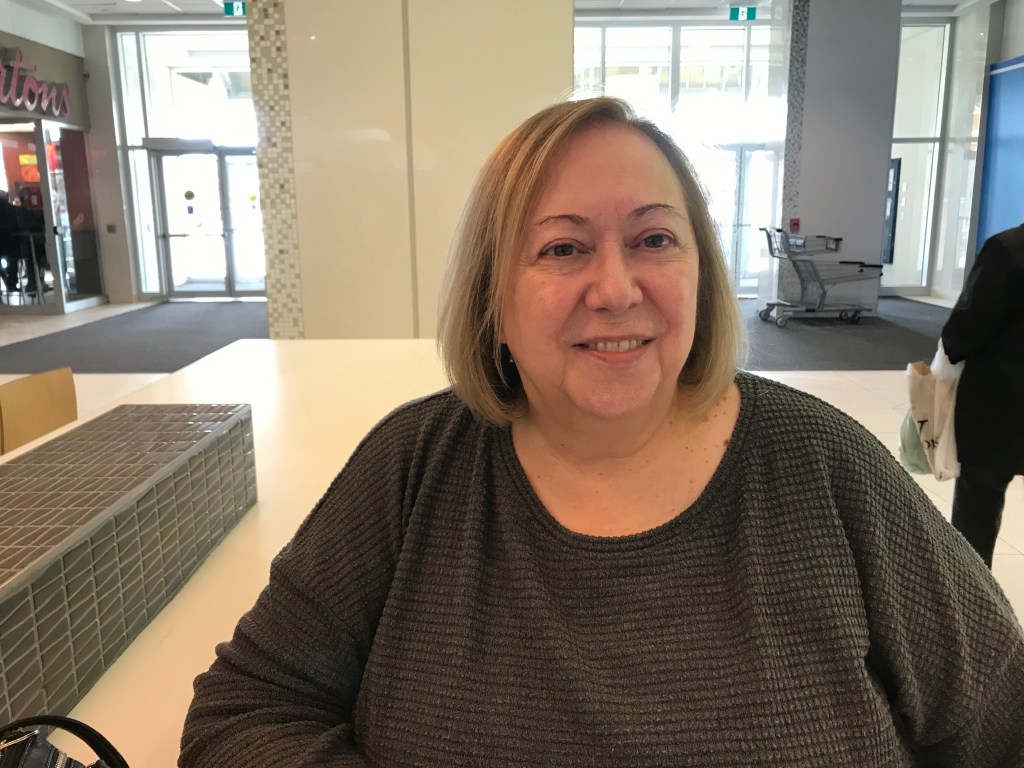
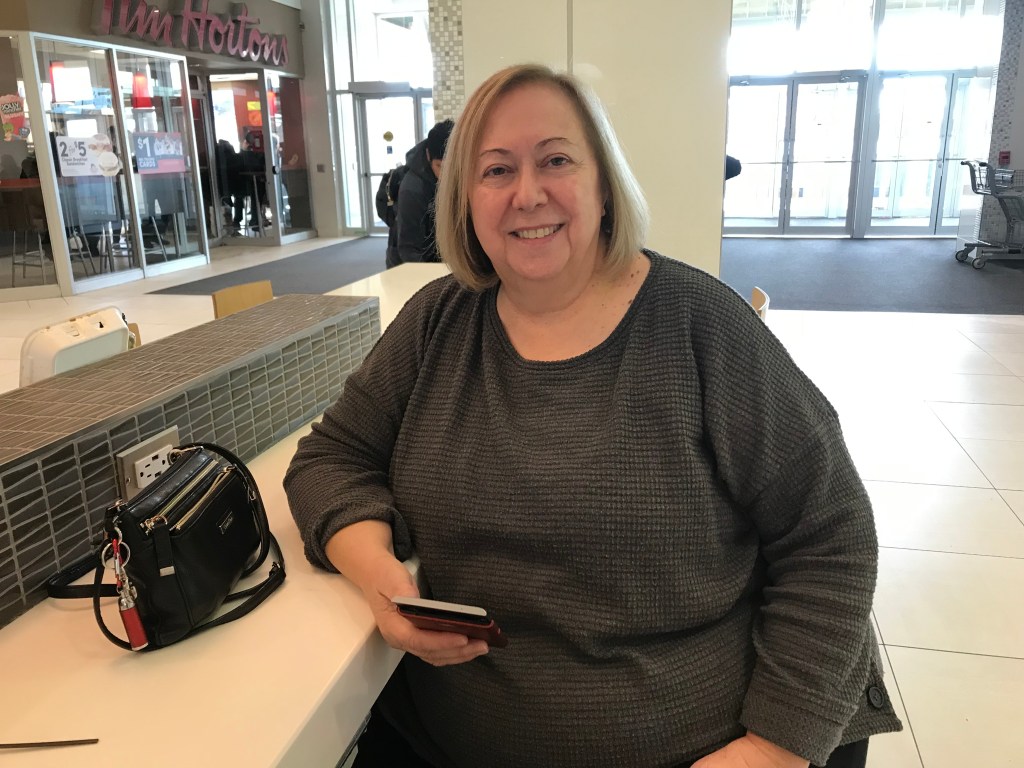
When I first see Lou she is sharing a table with two other women, a half-smile on her face.  I hesitate before approaching the trio, but the 69-year-old emanates a soft warmth, and I find myself asking her to share her story.  Lou cheerfully responds in the affirmative; it turns out her table companions are as unknown to her as I am.

It soon becomes apparent why she has decided to take the time to speak with a complete stranger.

“I am, actually, a little bored, because now I’m retired.  My husband won’t retire until next February,” she says with a chuckle.

Laughter comes quick and often to Lou; it is part of her charm, as is her straight-forward way of speaking.

“Do you know what it’s like to watch people take an hour to get to the point when you could just blurt it out?  You don’t have to accept my opinions, but at least you know what they are.”

This may explain, in part, Lou’s success as a (former) freelance marketer. 

“If you were on my project team there was always clarity.  That’s why I got so much done and I won so many awards.”

She smiles as she describes one of her longest stretches of employment.  Lou says she was originally hired to complete one contract for Nestle Canada but ended up working one project after another for 18 years.

“I worked in about every area for the company except for ice cream and water.  I had a lot of fun.”

If her long stretch at Nestle’s came as something of a surprise, it is no more surprising than the fact Lou ended up in marketing at all.  She has a degree in psychology from York University.

“But I knew I was too empathetic.  I knew I wouldn’t be able to help people.  So I went out into the world.”

Nonetheless, Lou admits she did try to help others as best she could over the years.  While she did not accomplish anything “world shattering”, she says she served as a mentor to countless youngsters.

“On a daily basis, you can help people as individuals and make a difference in their life.” 

Lou’s life began in Southern Italy.  She had three siblings. She describes a pleasant childhood, marred by one small regret, which illuminates her kind-hearted, gentle nature.  

“I once dropped dirt in my sister’s eye.  I’m still, to this day, ashamed of thinking that I did that.  The poor little thing may have been four.”  

When she herself was four, the family moved to Canada, to a home her father purchased in Forest Hill.

“He didn’t want to live near the Italian community because he said they gossiped too much,” she says with a grin.  

In fact, she recounts many stories of her parents with warmth and humour. 

“They were always on the same page.  They quite adored each other.” 

Lou, meanwhile, has been married to her university sweetheart since she was 24. 

“It is all about determination, picking the right person, who has a similar moral view.  And both of you believing you want to stay together.”

She says, however, marriage takes work.

“You fall in and out of love all the time.  That is a true marriage.  You fall out of love and then you fall in love again.”

Lou waited five years after marriage to have children, despite her mother’s impatience to become a grandmother.

“She asked me, about three years in, why I was not pregnant yet.  She said, ‘Why don’t you try it, you might like it?’” Lou recalls fondly.

Lou eventually had two sons, who are nine years apart.

“They aren’t doctors or lawyers, but they went to university.  One has an MBA, the other has a degree in science.  I’m a big believer in doing what makes you happy, because if you do what makes you happy, you will do well.”

Ironically, even though she originally told me she was retired, it is at this point I learn that she still works, at least part-time.  Six years ago, Lou launched a wine tour company of the Niagara Region with her sons.  

“It’s been pretty good,” she says, while we scroll through a website that is both artful and elaborate.  

Still, there is a hint of fatigue in her voice, when she admits, “It’s a lot of work.”

“All summer (he) never gets to see his family,” she says of her eldest.

In the off season, however, life is much less busy, with tours relegated to weekends.

“I’ve started taking watercolour, but I’m a control freak so I’m frustrated,” she says with a laugh.  “But I really like it.  I’m happy, but a little bored.”

She says she is now waiting on her husband’s imminent retirement, so they can do some travelling.  

In the next few years, she also hopes for more grandchildren.

“And I want to see my grandson married.”

It is an ambitious goal for a woman approaching 70.  Lou’s grandson is currently eight years old.  But the woman who was once called the “Sargeant Major” at work says she won’t let life “just go by.”

“I’m very determined.”

Mid-life angst: “How do you make a living, while enjoying, on some level, the thing that you do?”

S.P., 42

My Life in a Nutshell

  • I care about natural fibres and loathe synthetics
  • I wish others would stop wearing products made of oil and plastics
  • A significant hardship I’ve endured is “just life itself”
  • My greatest regret is not spending enough time on academics
  • An achievement I’m proud of is maintaining employment
  • Something I look back fondly on is going to Buffalo Bisons baseball games with my father
  • I was vegan for many years
  • I think others view me as quirky, interesting and smart
  • I wish others thought I was the most rich, handsome, fascinating man on the earth (who makes it all look so easy)

S.P.’s Story

At first glance, S.P. is a tall, lean man, with slightly dishevelled hair and a sparse moustache.  At 42, he appears considerably younger than his age, although he is wearing a sweater that would not look amiss on a senior citizen.

“I care about natural fibres. Unscented or organically scented products,” he says with a slight smile, before continuing to expound on the evils of synthetics.

“People are just literally wearing plastic bags for clothing. Their skin can’t breathe,” he adds. “Don’t sleep with plastic sheets and with plastic against your skin.”

It is an unconventional beginning to what will prove to be an unconventional conversation.  That being said, S.P. acknowledges his life, like many others, has been far from conventional.

“It was okay.  It was tumultuous, always tumultuous, but I wasn’t unhappy.”

S.P. was born in Toronto.  His father was an academic who taught at various universities; his mother, a government worker.  They split when he was nine.  S.P. spent the remainder of his childhood living primarily with his mother and older sister.

“You go through all this tumultuous stuff when you’re too young to be aware of anything.  Ie. my parents moved every six months, my dad was mean, my mom was overprotective, and then you’re into adulthood and you wonder — what was that all about?”

Nonetheless, he attempts to minimize the impact of his parents’ separation.

“All my friends were also fatherless, so it didn’t feel strange. It was the 1980’s.  Kramer vs. Kramer.  I believe it set the tone for the decade.  It normalized divorce.”

Recriminations soon follow, however, when he describes a subsequent decline in his grades, and an inattention to academics.


“The number one determinant of success is stable and involved parents,” he opines.  “It goes beyond sex, socio-economics, anything else.”

A failed reconciliation attempt also left wounds. 

“I just remember feeling angry.  I was just always in a lot of emotional pain, almost all of the time.  I still am.”


Although bright and contemplative, S.P. did not complete college or university.  He says he spent much of his twenties and thirties questioning his path, partying and bouncing from job to job. 

“Like what do you do with your life?  How do you make a living, while enjoying, on some level, the thing that you do?”

S.P. spent time as a tour guide, tried his hand at photography, worked as a DJ, and became vegan for five years.

“I guess it was fairly interesting.  Certainly there was a lot going on.  You’re young enough to feel like life is forever.”

Currently, S.P. is a producer at a software start-up, a job he says he enjoys for the most part.  He is also an uncle of three, and has a live-in girlfriend.  He says they are surrounded by children, although they have none of their own.  So far, his forties have been a time of stability and relative comfort. 

“I don’t really party.  I eat pretty well.  I just like having a girlfriend, the apartment.  I would exercise more, but I’m not doing so bad.”

That being said, S.P. still spends a lot of time pondering “the messy, mystery of life, and what you’re supposed to do.”

At present, though, he wants for little.  Eventually, he says he wants to marry and spend his life with someone.  Despite his parents’ divorce, he still believes it is possible to remain with one person forever.

As for the future?

“I just want to make enough money to live and not do something I hate.”

Injuries drastically alter life of “mountain man”

Ronald Piet, 62

My Life in a Nutshell

  • I care about high-quality music, audio and video productions
  • I wish others cared more about noise pollution
  • A significant hardship I’ve endured is dealing with the aftermath of a streetcar collision
  • I’ve been married and divorced twice
  • My greatest regret is not having children
  • Something I look back fondly on is living off-the-grid for two years
  • I think others view me as sensitive, intelligent and kind, and think I’m a great cook
  • I am generally happy
  • I would have liked to have travelled more to see other continents and their art and culture

Ronald’s Story

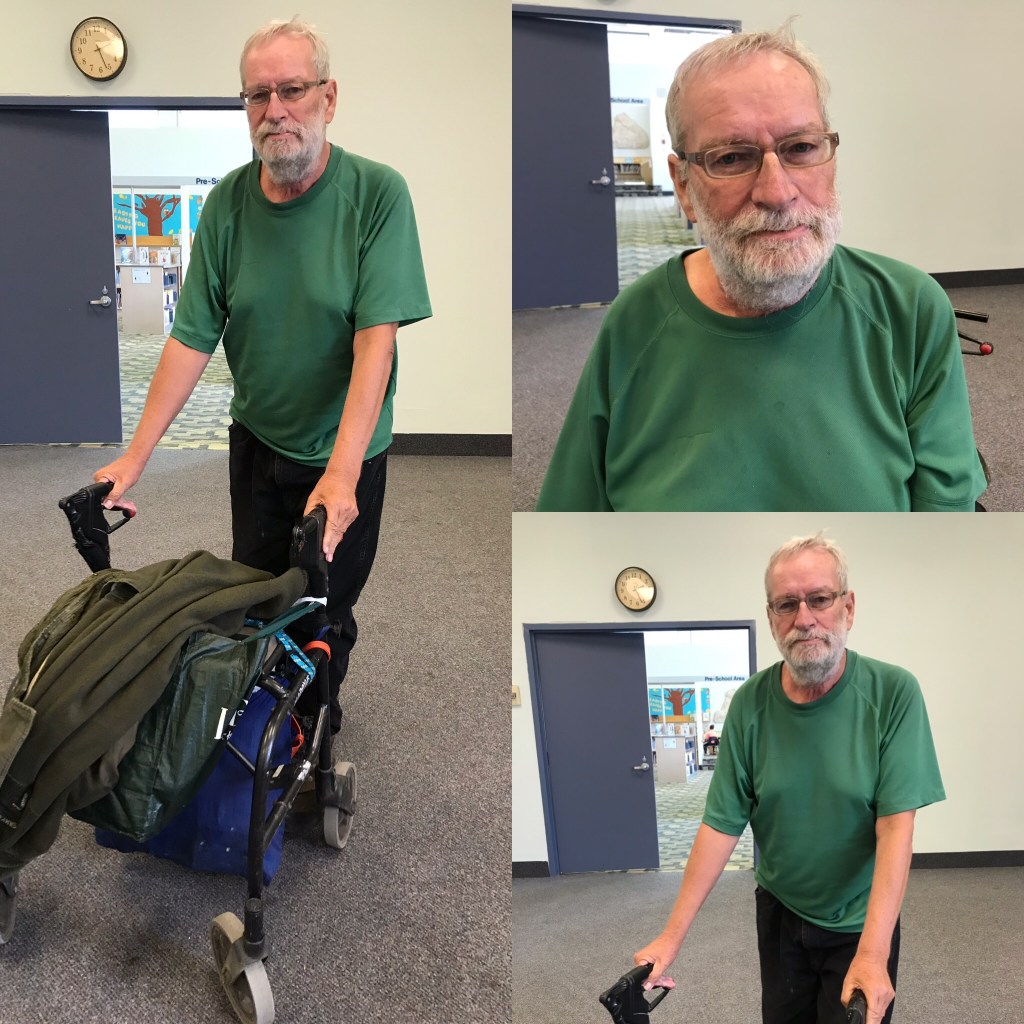
With the help of a walker that’s heavily laden down with bags and articles of clothing, Ronald Piet slowly makes his way into Toronto’s Forest Hill library. Pain is evident in his movements, his gait unsteady and faltering.

“What weighs me down is my injury,” he says. “Pain, physical pain in my legs, neck and back.”

The 62-year-old says he was in a streetcar collision eight years ago and suffered spinal damage, which causes chronic pain.

It is a difficult fate for a man who was an avid outdoorsman in the not-too-distant past.

“You might have called me a wilderness man.”

While Piet currently lives in a one-bedroom apartment in the Bathurst and Eglinton area, just ten years ago, home was a remote cabin on Manitoulin Island, with no running water or electricity.

“No one would know it by looking at me that I was practically a mountain man,” he says with a chuckle. “I went out hunting with a bear nearby, fishing, wildcrafting, gathering fruits, nuts.”

Piet says he lived off-the-land in this cabin for six years on a part-time basis, before he relocated there full-time for two years.

“I do enjoy being in nature and I also like challenges, and I also like doing new things that I never considered doing before.”

Still, in a life marked by contrasts, life in the North was a far cry from where Piet started out.

The retiree was born in Hamilton, Ontario, one of three sons of Dutch emigrates. He says his childhood was “not particularly good.”

Piet describes his parents, who remained together until their deaths, as “stingy and unkind.”

He says not only would they never acknowledge his excellent grades and other accomplishments, but “both of my parents hit me. Frequently.”

Piet says this is why solitary activities have always appealed to him.

“For example, at the age of ten, I created my own darkroom and started processing film. I was self-taught. I enjoyed it because it was a technical challenge, and it was something you could measure yourself against others with.”

It is this interest in photography that would eventually lead him into a career working with film.

Piet started his working life as a salesperson in a camera store in Dundas, Ontario, and eventually transitioned to processing colour prints and slides at a still photography lab. He is particularly proud of some of his professional photography.

“I did some really fine music concert photography, and MuchMusic bought some to decorate their halls with at one point.”

Eventually, however, Piet says he could not resist the call of the wild, abandoning his job in his forties, to move to Manitoulin Island.

He says his ingrained studiousness served him well. Piet says he learned to live off the land, in large part, by reading and studying, and through trial and error. For those considering making a similar move, Piet says a good place to start is by learning to fish and hunt small game, like rabbit.

“And then you go and spend time, patiently, pursuing those things because both of those activities require a long period of time when you’re not even talking.”

His German Shepherd “Freedom” kept him company, but the isolation would sometimes be hard to deal with.

“Well, books (were) very important, and I also had a good AM radio that I would listen to talk radio shows late at night when I had nothing else to do, and on intriguing subjects or whatever was going on that was important to other people in the world.”

But living off-the-land was not sustainable in the long-run. And when the money ran out, Piet left rural Ontario, for life in Canada’s largest city, after obtaining a job at Deluxe Labs, an Etobicoke picture and sound post-production house.

“You would run test strips, watch on a monitor as the film was coming through, and then you’d know if you had to do anything — adjust colour balance and density, and see whether any other flaws were showing up.”

“I immensely enjoyed that job. To me, it wasn’t even work.”

He says, however, in 2011 he lost his job due to the “whole digital revolution”, an experience that made him “heartsick.”

After six months on the job hunt, Piet decided to make a career change and train to become an RMT. He had just been accepted into a program when he had his accident.

Piet now lives on assistance from the Ontario Disability Support Program.

“It’s hard to make ends meet. It would be impossible if I lived alone,” he says. “But I have a roommate. It keeps loneliness at bay. We watch shows together, do crosswords, have conversations about various things.”

Piet was married twice, but neither relationship lasted. Still, the loss of his wives is not what he mourns most in life. He says apart from his injury, his greatest regret is that he never had children.

“I think about that often, especially as I get older. Like Thanksgiving is coming, every holiday is difficult. Christmas is a big one. It gets lonely.”

Nonetheless, Piet counts himself happy. He loves to cook, and the self-described audiophile enjoys “real high-quality music and audio and video productions. I’m very interested in film and music that is very well-produced.”

And while Piet knows the pain from his injuries is not likely to improve, he still has hope for the future.

“That I live out the rest of my life in reasonable comfort, access to groceries, with a pretty good kitchen and a good sound system and computer and monitor.”