Ronald Piet, 62
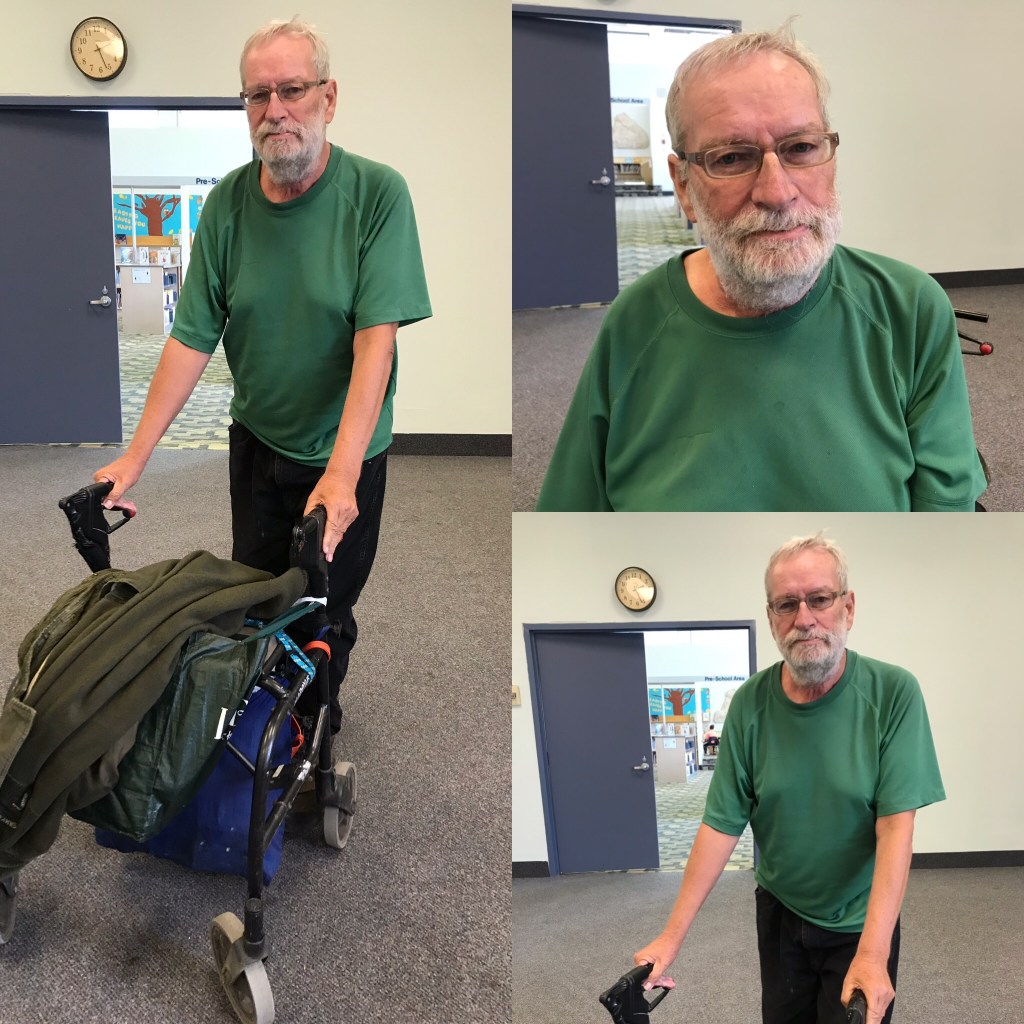
My Life in a Nutshell
- I care about high-quality music, audio and video productions
- I wish others cared more about noise pollution
- A significant hardship I’ve endured is dealing with the aftermath of a streetcar collision
- I’ve been married and divorced twice
- My greatest regret is not having children
- Something I look back fondly on is living off-the-grid for two years
- I think others view me as sensitive, intelligent and kind, and think I’m a great cook
- I am generally happy
- I would have liked to have travelled more to see other continents and their art and culture
Ronald’s Story
With the help of a walker that’s heavily laden down with bags and articles of clothing, Ronald Piet slowly makes his way into Toronto’s Forest Hill library. Pain is evident in his movements, his gait unsteady and faltering.
“What weighs me down is my injury,” he says. “Pain, physical pain in my legs, neck and back.”
The 62-year-old says he was in a streetcar collision eight years ago and suffered spinal damage, which causes chronic pain.
It is a difficult fate for a man who was an avid outdoorsman in the not-too-distant past.
“You might have called me a wilderness man.”
While Piet currently lives in a one-bedroom apartment in the Bathurst and Eglinton area, just ten years ago, home was a remote cabin on Manitoulin Island, with no running water or electricity.
“No one would know it by looking at me that I was practically a mountain man,” he says with a chuckle. “I went out hunting with a bear nearby, fishing, wildcrafting, gathering fruits, nuts.”
Piet says he lived off-the-land in this cabin for six years on a part-time basis, before he relocated there full-time for two years.
“I do enjoy being in nature and I also like challenges, and I also like doing new things that I never considered doing before.”
Still, in a life marked by contrasts, life in the North was a far cry from where Piet started out.
The retiree was born in Hamilton, Ontario, one of three sons of Dutch emigrates. He says his childhood was “not particularly good.”
Piet describes his parents, who remained together until their deaths, as “stingy and unkind.”
He says not only would they never acknowledge his excellent grades and other accomplishments, but “both of my parents hit me. Frequently.”
Piet says this is why solitary activities have always appealed to him.
“For example, at the age of ten, I created my own darkroom and started processing film. I was self-taught. I enjoyed it because it was a technical challenge, and it was something you could measure yourself against others with.”
It is this interest in photography that would eventually lead him into a career working with film.
Piet started his working life as a salesperson in a camera store in Dundas, Ontario, and eventually transitioned to processing colour prints and slides at a still photography lab. He is particularly proud of some of his professional photography.
“I did some really fine music concert photography, and MuchMusic bought some to decorate their halls with at one point.”
Eventually, however, Piet says he could not resist the call of the wild, abandoning his job in his forties, to move to Manitoulin Island.
He says his ingrained studiousness served him well. Piet says he learned to live off the land, in large part, by reading and studying, and through trial and error. For those considering making a similar move, Piet says a good place to start is by learning to fish and hunt small game, like rabbit.
“And then you go and spend time, patiently, pursuing those things because both of those activities require a long period of time when you’re not even talking.”
His German Shepherd “Freedom” kept him company, but the isolation would sometimes be hard to deal with.
“Well, books (were) very important, and I also had a good AM radio that I would listen to talk radio shows late at night when I had nothing else to do, and on intriguing subjects or whatever was going on that was important to other people in the world.”
But living off-the-land was not sustainable in the long-run. And when the money ran out, Piet left rural Ontario, for life in Canada’s largest city, after obtaining a job at Deluxe Labs, an Etobicoke picture and sound post-production house.
“You would run test strips, watch on a monitor as the film was coming through, and then you’d know if you had to do anything — adjust colour balance and density, and see whether any other flaws were showing up.”
“I immensely enjoyed that job. To me, it wasn’t even work.”
He says, however, in 2011 he lost his job due to the “whole digital revolution”, an experience that made him “heartsick.”
After six months on the job hunt, Piet decided to make a career change and train to become an RMT. He had just been accepted into a program when he had his accident.
Piet now lives on assistance from the Ontario Disability Support Program.
“It’s hard to make ends meet. It would be impossible if I lived alone,” he says. “But I have a roommate. It keeps loneliness at bay. We watch shows together, do crosswords, have conversations about various things.”
Piet was married twice, but neither relationship lasted. Still, the loss of his wives is not what he mourns most in life. He says apart from his injury, his greatest regret is that he never had children.
“I think about that often, especially as I get older. Like Thanksgiving is coming, every holiday is difficult. Christmas is a big one. It gets lonely.”
Nonetheless, Piet counts himself happy. He loves to cook, and the self-described audiophile enjoys “real high-quality music and audio and video productions. I’m very interested in film and music that is very well-produced.”
And while Piet knows the pain from his injuries is not likely to improve, he still has hope for the future.
“That I live out the rest of my life in reasonable comfort, access to groceries, with a pretty good kitchen and a good sound system and computer and monitor.”
 A Life Beneath