Single by choice: “Men that chased me I should just run, run around like the devil and not stop”

Anne Elizabeth, 78

My Life in a Nutshell

  • I lived in Toronto for 35 years, but have moved home to rural Ontario
  • I have been married twice and have not been lucky in love, “the first was a tyrant, the second an alcoholic”
  • I had a great childhood, “because we had more money than most kids. So we had the best of food, the best of toys, and our mom and dad took us on a trip every year, and we would go out every weekend. We would go to the movies every Saturday night, and out for a little treat.”
  • I’m proud of the fact I went back to school and got my high school diploma at 25
  • I care most about my family and my animals
  • I don’t think people care enough about each other
  • I enjoy a pint of beer a day
  • I love cooking, baking, dancing, home decorating and playing cards
  • My life wasn’t necessarily a happy one, but it wasn’t all unhappiness either
  • I couldn’t care less how others view me

Anne’s Story

(In my last post, I interviewed Bob. In this post I interview Anne, his older sister.)

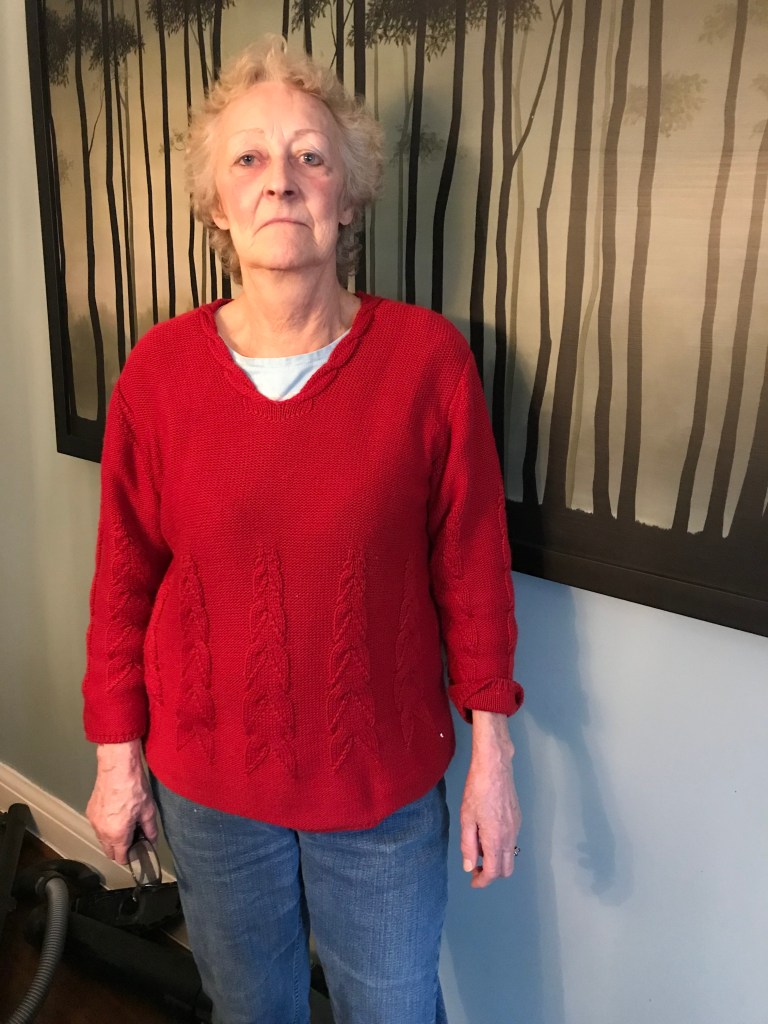
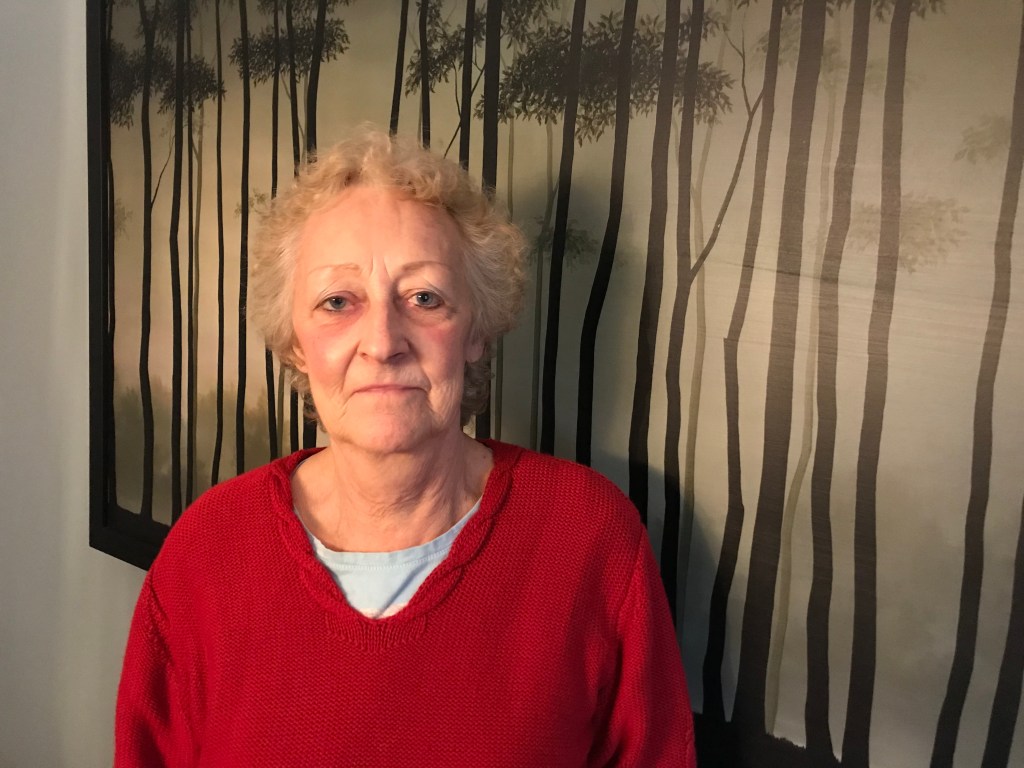
Anne is 78-years-old, but looks significantly younger. She is tidy and well-kept, wearing relaxed jeans and a bright sweater, and her deep blue eyes are enhanced with just a touch of makeup. Despite her age, her face has remarkably few lines, and her expression is alert and lively. Still, a touch of sadness tinges her expression, which is most evident in the downward turn of her mouth.

Nonetheless, the retiree describes the last 20 years as “the happiest years of my life.”

Anne says that’s because she’s been single for exactly two decades.

“It’s all one-sided,” she says of marriage.

Anne has been married twice, and says her marriages were the most significant hardships she’s ever endured.

“All men are like babies. Men are exactly like babies. It has to be their way or the highway. So I said, ’take the highway.’”

Anne was born in rural Ontario in July 1941. She says, like her sister and her mother before her, she married at 17. She says marrying in your teens was not uncommon then, and Anne believed she was in love.

“I thought it was like a fairy tale.”

But marriage to her first husband turned out to be anything but.

“The first was a tyrant.”

She gives an example of life with Raymond.

“One time, my first husband got really mad at me. And I went down to my mom and dad’s, and when I come home he had the shotgun. I had to run in the field and duck.”

She says he shot at her a “couple times” because he was angry she had refused to go to a dance with him.

The marriage didn’t last more than a couple years after that point, and she left when she was 28.

“I had a job at the hospital and I worked in payroll and Human Resources, so I finally said ‘I can support myself so I’m leaving.’”

Leaving wasn’t as plausible only a few years earlier. Anne says she only had a grade 9 education when she wed.

“And women didn’t work in those days, the way they do now. There were only teachers, librarians and nurses. Very few women worked, they stayed home and looked after their family.”

But she says three years after getting married, she decided to go back to school. Anne was 21 at the time.

“I went back for four years to high school and got my 10, 11, 12 and 13.”

She describes this as the accomplishment she’s most proud of in her life.

“I was the first woman, or, in fact, male or female in our town that ever went back to high school after I was married. And then others followed.”

She says getting her diploma opened doors, and she was able to leave her first marriage.

But it wasn’t long before she would meet her second husband.

“Out of the frying pan and into the fire.”

Anne describes her second husband as “worse than the first. The next was an alcoholic.”

She says Robert always drank, but his alcohol consumption got heavier over time. She says she should have known how bad he would get, given his family history.

“They were all drunks except one,” she says.

“My mother never liked either one (of my husbands). She could tell. She could tell.”

Anne declines to describe anything more about her 13-year marriage to Robert, although she says there are a lot of bad memories: “too many to tell you.”

After divorcing her second husband, with whom she had moved to Toronto, Anne had three subsequent relationships, and was even engaged one more time.

“They were a disaster too,” she says.

“Men that chased me — I should just run, run around like the devil and not stop.”

Anne says she wanted to be a homemaker, but that was never really a choice.

“I wasn’t crazy over working but it was a necessity. I had to support myself.”

Anne is proud of the work she’s done, and you can hear the pleasure in her voice when she describes how she was treated with respect and appreciation, given she was so “highly organized.”

“I would rather have been happily married and had children and that little white picket fence, but no, it never happened to me.”

Anne never had children of her own, but says her brother always reminds her, “don’t say you never had children. Because you helped bring up mine and you helped bring up Tracy (her sister’s son).”

She has fond memories of dinners and movies and excursions with her nieces and nephews over the years.

“That’s what I remember. The highlights is having the kids.”

Apart from her marriages, Anne says she has no regrets, and she “couldn’t care less” how others view her. She says for her, the most important thing in life is family.

“I really have nothing else. And my little animals. My little animal family. I love those.”

Anne has always had dogs, and at times, she took care of the occasional cat.

“They’re the things that were completely mine that I loved and looked after, and they were just mine. They’re such loveable little things and they need loving and attention and you love them and they love you.”

Anne says she has never felt lonely without a partner. After her father died ten years ago, she left Toronto and moved home to rural Ontario, and currently lives with her brother. Her sister and brother-in-law of 56 years live in the house next door.

While she takes care of the cooking, laundry, interior painting and decorating, Anne says her brother does the “roofing and all that stuff.”

“I guess stuff I couldn’t. I only do women’s jobs, which I don’t think putting up light fixtures is a woman’s job.”

She says this “traditional” arrangement works well for them.

Currently, Anne says her life is quite busy. In the summer, she loves gardening, and year-round she likes cooking and hosting dinner parties. She especially enjoys baking, which she does often for the Anglican Church in town.

“Well, my mother was a cook. Her mother was a cook. My sister was a cook for a living. So it runs in the family.”

When asked about the future, she replies with a bark of a laugh, “What future? I’m 78.”

“I take it a day at a time, is all I do. If I wake up in the morning, that’s great. I got one more day.”
Out of the spotlight: “I’m just another face in the crowd, that’s all”

Bob, 75

My Life in a Nutshell

  • I’m a widower and retiree who lives in rural Northern Ontario, and come from “the last generation of frontier people.”
  • I care about my family: “I’d like to see them happy”
  • I wish people cared more about the truth
  • I look back fondly on my childhood, “because my family had a large general store and there were still a lot of people in the community. We used to have a lot of good times during the holidays, Easter, Christmas and so on. We used to go blueberry picking together and all that”
  • I love to draw and paint and wanted to be an artist, but I never pursued it because “it seemed frivolous”
  • my wife and I faced discrimination because people weren’t as accepting of interracial marriage in the 1970s
  • my greatest regret is I that I didn’t “treat my wife better,” I didn’t understand how PTSD from her childhood impacted her throughout her life
  • I was an Olympic-calibre athlete but suffered a severe spinal injury
  • I was once an atheist but now believe in God
  • I built my family home and I built my cabin single-handedly
  • my life became a disappointment but I am still “basically happy”

Bob’s Story

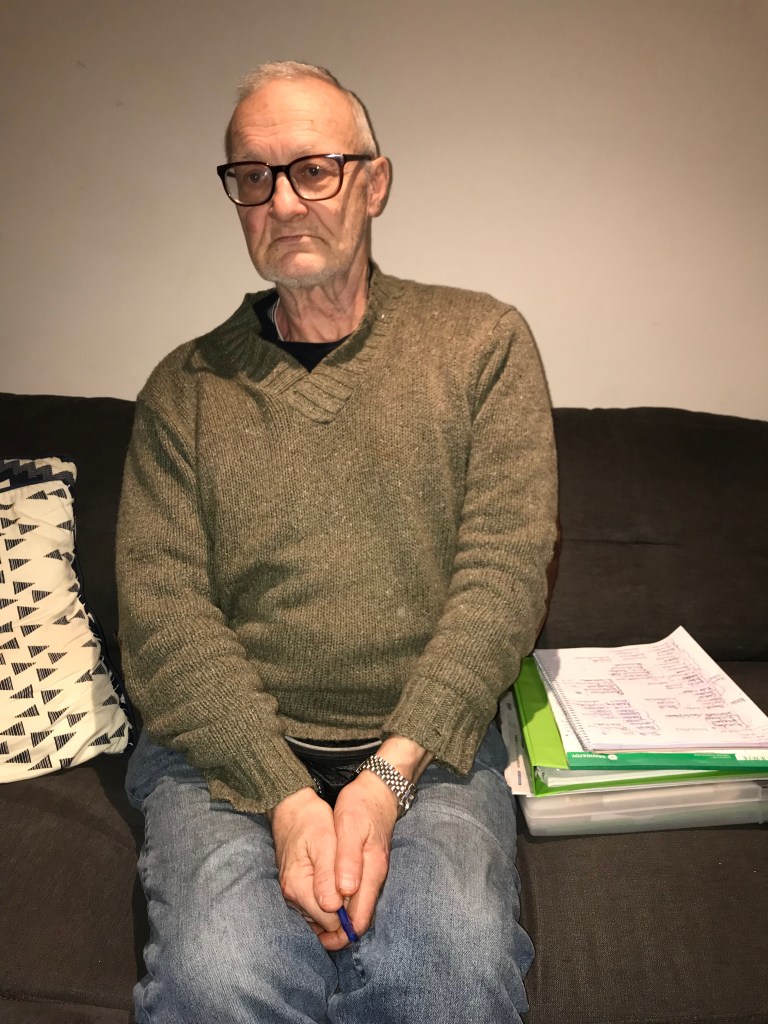
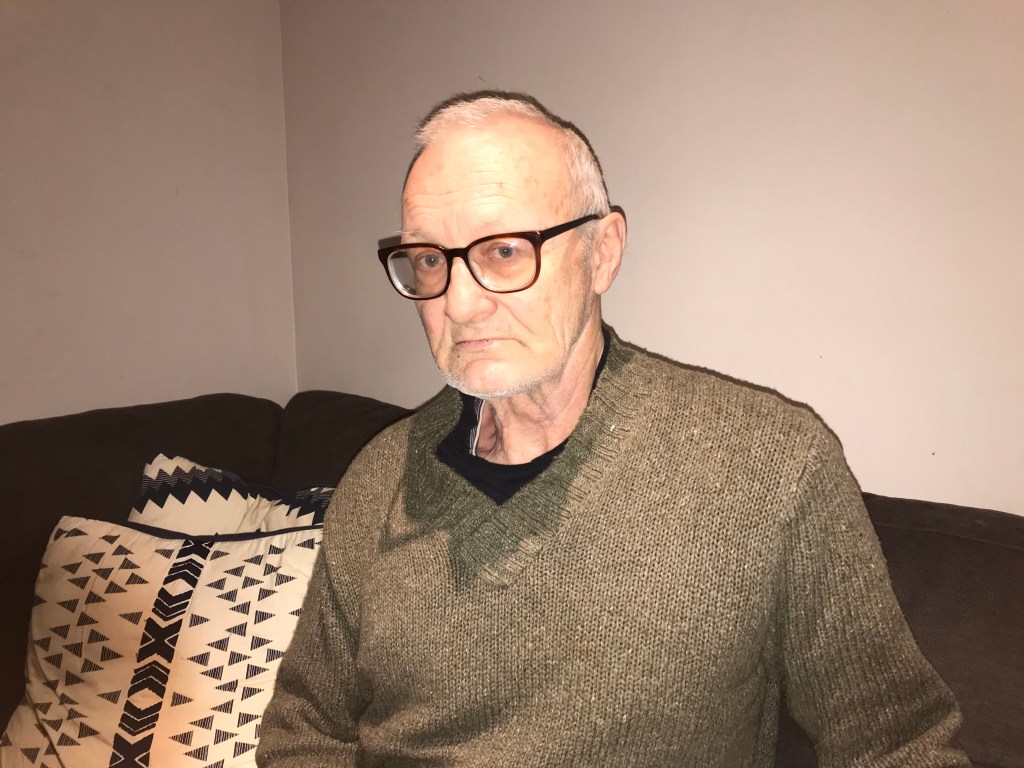
Bob’s face is bristled with a light dusting of white whiskers, his hair, what remains of it, is trimmed close to his head. He is not a frail older man; nor, however, is he glowing with health. He is well-built, though, particularly for a 75-year-old man, despite the fact he appears fatigued.

When I sit down with him he is writing notes in lined a notepad.

“I’m making lists. This one is about all the foods I can grow in my garden. This one is about new research, new ideas. You can always find an interesting book, some of them on cancer.”

Bob reveals he has battled cancer this year, and spent nine months receiving chemotherapy and other treatments.

“From the time I was a little boy I always liked to have warm feet,” he says. “Now that I had chemo for cancer I’m having trouble with cold feet.”

Bob says he discovered some lumps in his abdomen and groin more than two years ago, but he ignored them until he experienced a “severe pain” last December. He went to see a doctor, and a slew of appointments with specialists soon followed. Bob would learn he had lymphoma just after Christmas.

“It was hard to endure, but I never doubted I would get better. And when I learned to pray and asked God to heal me — it just disappeared. I can’t say for sure that God healed me, it could have been the medicine, but everybody was surprised, including the oncologist.”

Bob finished chemo this summer, and just last week had his three-month checkup. Thankfully, there was still no trace of cancer in his body.

“I was surprised, I was expecting to go through radiation therapy.”

Cancer is a terrifying diagnosis, and chemotherapy is notoriously unpleasant. Still, this is not what Bob would describe as the greatest hardship he’s ever endured. He says he suffered a spinal injury when he was at a track and field meet in high school, and for a short time he couldn’t walk.

“I had this terrible fear. I realized: ‘I’m paralyzed. I’m not going to live this way. I’m going to kill myself.’ My intention was to hang myself, because I could still do that.”

But Bob says his back miraculously repaired itself. Once again, he credits God for his recovery.

It is an interesting turnabout, for a man who was a self-admitted atheist most of his life. Bob says he only became religious in the last few years.

“I learned how to pray. So my prayers can be heard in heaven.”

While religion currently preoccupies him, Bob’s life has been one of exploration — both literally and figuratively. He loves books, reading and reflection, but he also loves the outdoors. He has lived across the country, in both rural and urban settings, and has had a variety of careers — from landscaping and forestry, to owning and operating a restaurant and two corner stores.

“I wasn’t particularly interested in anything, so I just wandered around from one thing to the other, to keep from getting too bored with life.”

Bob actually met his wife of 35 years when he was the supply manager in a hospital in small-town Ontario.

“She came here as a nurse. She’d been in Newfoundland and she was lonely. There were no Koreans there and she could barely speak English. So when she heard there were some Korean girl nurses in the hospital where I was, she came over.”

They married ten months later. He built the home they lived in when she was pregnant, and their first child was just an infant.

“I started in August one year, and I finished it in the spring, the next year, because we moved in in June.”

I express surprise that he built the family home, a four-bedroom with a greenhouse, completely on his own.

“Well, in the country, people did most of their own building,” he says. “I like working with groups of men outside. I used to get involved with building, watching them, working on barns and that sort of thing.”

Bob describes his marriage as having many highs and lows. He says his wife lived through the Korean War and suffered from PTSD, something he wishes he’d better understood when he was younger.

“If there was 50 ways to go from point A to point B I would want to take every one — one after the other — to see what was there. But not her. She had to always have the exact same routine, or she would go nuts. She couldn’t take any stress.”

Bob says he and his wife could not have been more different. He had a “happy childhood”, while she grew up in wartime and lost her father. She was also from Seoul, a huge city, while he was born and raised in rural Canada.

But when they met, he says, “there was instant recognition.”

Still, while he never “thought a whole lot” about the fact his wife was a different race, he says others did question their decision to marry.

“Because it wasn’t that common.”

He says, at times, they faced discrimination — and it didn’t matter if they were living in a small town or a larger city. And they faced condemnation from both caucasians and asians. Thankfully, he says, people’s attitudes are changing.

“It’s becoming more common, interracial marriage.”

His wife died 15 years ago, from pancreatic cancer.

“Oh, that was difficult. But the marriage was slowly coming apart because we had such different backgrounds,” he says. “I didn’t really adapt well to living in the city because all of my education was in forestry and agriculture.”

Still, he lists getting married as a highlight of his life, along with the moments his two children were born.

Now, he says, his greatest hope for the future is: “to live long enough to see my grandkids growing up.”

And while he says he has regrets, and has “often” made bad decisions, he is content.

“More or less. I don’t know if I ever knew joy, but I’ve always basically been happy.”

Bob is currently retired. He owns a home he shares with his sister, often visits a cabin he built himself, and lives surrounded by close family.

“I’m just another face in the crowd, that’s all. I’ve never been important,” he says. After a short pause, he adds, “I never wanted to be.”

Injuries drastically alter life of “mountain man”

Ronald Piet, 62

My Life in a Nutshell

  • I care about high-quality music, audio and video productions
  • I wish others cared more about noise pollution
  • A significant hardship I’ve endured is dealing with the aftermath of a streetcar collision
  • I’ve been married and divorced twice
  • My greatest regret is not having children
  • Something I look back fondly on is living off-the-grid for two years
  • I think others view me as sensitive, intelligent and kind, and think I’m a great cook
  • I am generally happy
  • I would have liked to have travelled more to see other continents and their art and culture

Ronald’s Story

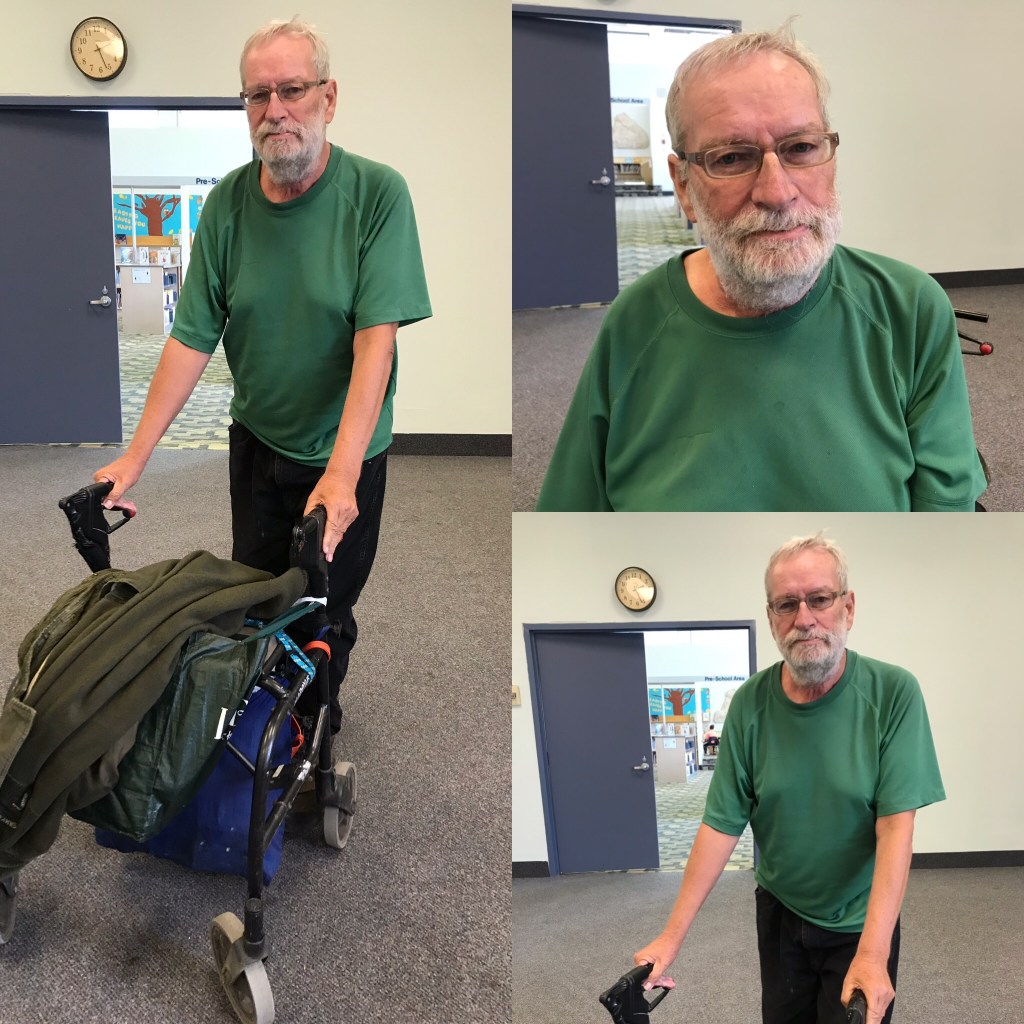
With the help of a walker that’s heavily laden down with bags and articles of clothing, Ronald Piet slowly makes his way into Toronto’s Forest Hill library. Pain is evident in his movements, his gait unsteady and faltering.

“What weighs me down is my injury,” he says. “Pain, physical pain in my legs, neck and back.”

The 62-year-old says he was in a streetcar collision eight years ago and suffered spinal damage, which causes chronic pain.

It is a difficult fate for a man who was an avid outdoorsman in the not-too-distant past.

“You might have called me a wilderness man.”

While Piet currently lives in a one-bedroom apartment in the Bathurst and Eglinton area, just ten years ago, home was a remote cabin on Manitoulin Island, with no running water or electricity.

“No one would know it by looking at me that I was practically a mountain man,” he says with a chuckle. “I went out hunting with a bear nearby, fishing, wildcrafting, gathering fruits, nuts.”

Piet says he lived off-the-land in this cabin for six years on a part-time basis, before he relocated there full-time for two years.

“I do enjoy being in nature and I also like challenges, and I also like doing new things that I never considered doing before.”

Still, in a life marked by contrasts, life in the North was a far cry from where Piet started out.

The retiree was born in Hamilton, Ontario, one of three sons of Dutch emigrates. He says his childhood was “not particularly good.”

Piet describes his parents, who remained together until their deaths, as “stingy and unkind.”

He says not only would they never acknowledge his excellent grades and other accomplishments, but “both of my parents hit me. Frequently.”

Piet says this is why solitary activities have always appealed to him.

“For example, at the age of ten, I created my own darkroom and started processing film. I was self-taught. I enjoyed it because it was a technical challenge, and it was something you could measure yourself against others with.”

It is this interest in photography that would eventually lead him into a career working with film.

Piet started his working life as a salesperson in a camera store in Dundas, Ontario, and eventually transitioned to processing colour prints and slides at a still photography lab. He is particularly proud of some of his professional photography.

“I did some really fine music concert photography, and MuchMusic bought some to decorate their halls with at one point.”

Eventually, however, Piet says he could not resist the call of the wild, abandoning his job in his forties, to move to Manitoulin Island.

He says his ingrained studiousness served him well. Piet says he learned to live off the land, in large part, by reading and studying, and through trial and error. For those considering making a similar move, Piet says a good place to start is by learning to fish and hunt small game, like rabbit.

“And then you go and spend time, patiently, pursuing those things because both of those activities require a long period of time when you’re not even talking.”

His German Shepherd “Freedom” kept him company, but the isolation would sometimes be hard to deal with.

“Well, books (were) very important, and I also had a good AM radio that I would listen to talk radio shows late at night when I had nothing else to do, and on intriguing subjects or whatever was going on that was important to other people in the world.”

But living off-the-land was not sustainable in the long-run. And when the money ran out, Piet left rural Ontario, for life in Canada’s largest city, after obtaining a job at Deluxe Labs, an Etobicoke picture and sound post-production house.

“You would run test strips, watch on a monitor as the film was coming through, and then you’d know if you had to do anything — adjust colour balance and density, and see whether any other flaws were showing up.”

“I immensely enjoyed that job. To me, it wasn’t even work.”

He says, however, in 2011 he lost his job due to the “whole digital revolution”, an experience that made him “heartsick.”

After six months on the job hunt, Piet decided to make a career change and train to become an RMT. He had just been accepted into a program when he had his accident.

Piet now lives on assistance from the Ontario Disability Support Program.

“It’s hard to make ends meet. It would be impossible if I lived alone,” he says. “But I have a roommate. It keeps loneliness at bay. We watch shows together, do crosswords, have conversations about various things.”

Piet was married twice, but neither relationship lasted. Still, the loss of his wives is not what he mourns most in life. He says apart from his injury, his greatest regret is that he never had children.

“I think about that often, especially as I get older. Like Thanksgiving is coming, every holiday is difficult. Christmas is a big one. It gets lonely.”

Nonetheless, Piet counts himself happy. He loves to cook, and the self-described audiophile enjoys “real high-quality music and audio and video productions. I’m very interested in film and music that is very well-produced.”

And while Piet knows the pain from his injuries is not likely to improve, he still has hope for the future.

“That I live out the rest of my life in reasonable comfort, access to groceries, with a pretty good kitchen and a good sound system and computer and monitor.”