Paul, 41
My Life in a Nutshell
- I’m a freelance journalist, who was born and raised in North Toronto
- I try to stay “relentlessly positive”, but I can’t see where the journalism industry is going “other than down”
- I have a Bachelor of Science and a Masters of Journalism, and my passion is science reporting
- I want to inspire people to “appreciate how amazing and cool and intricate things are”
- I wish people cared more about the English language, and not butchering it
- one of my best experiences was working on my own science program in Moscow for three years
- my childhood had “happy moments” but it was also “very turbulent” due to my father’s mental illness (schizophrenia)
- I struggle with anxiety and depression, but have found rTMS treatment “life-altering”
- I think people see me as nice and smart, but also as a bit of a pushover, and that’s something I’m always trying to work on
- I would like people to see me as a kind and fair person
- I work out nearly every day
- I would like a baby in the future, which also requires making more money, which I am determined to be more “aggressive” about
Paul’s Story
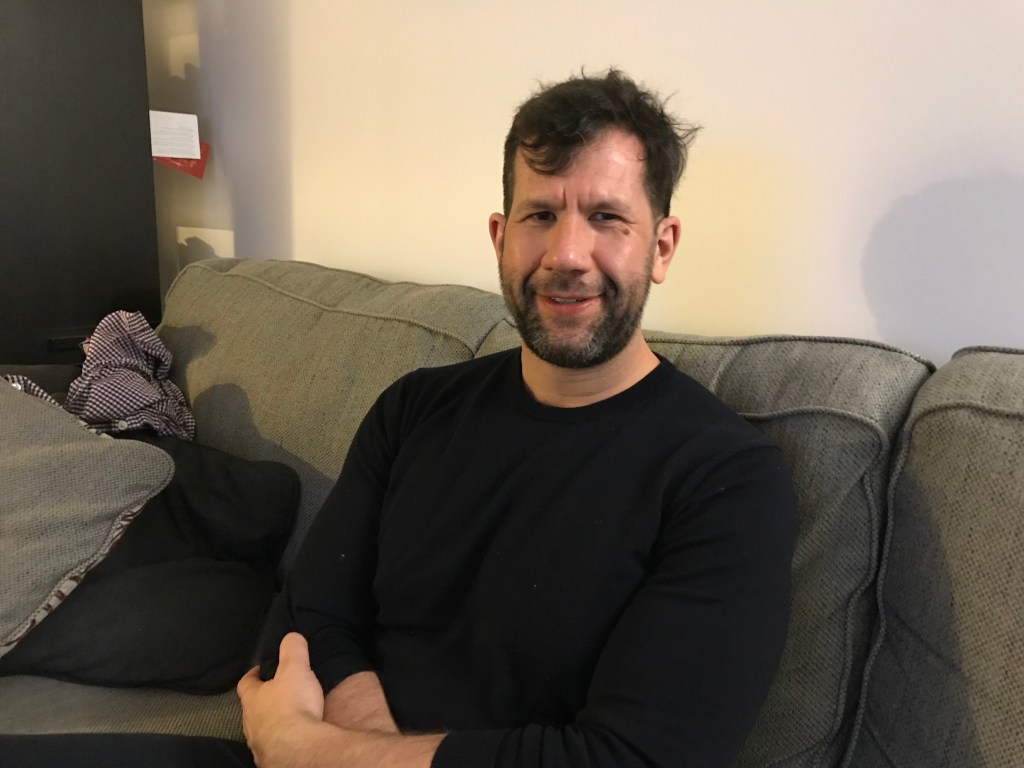
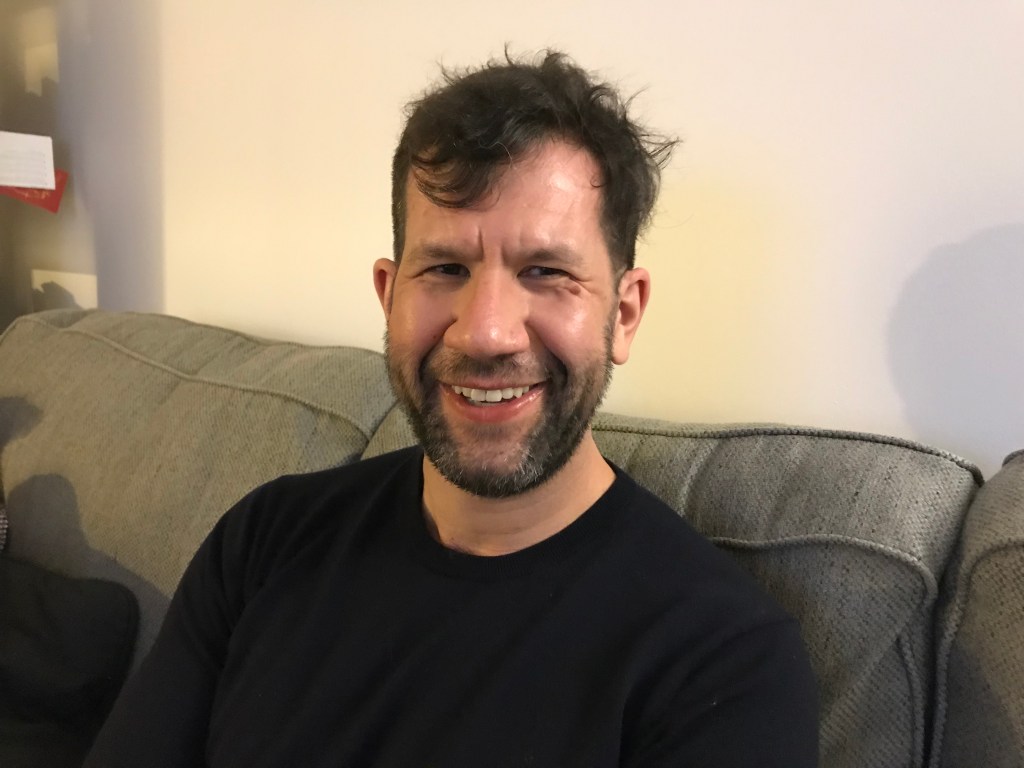
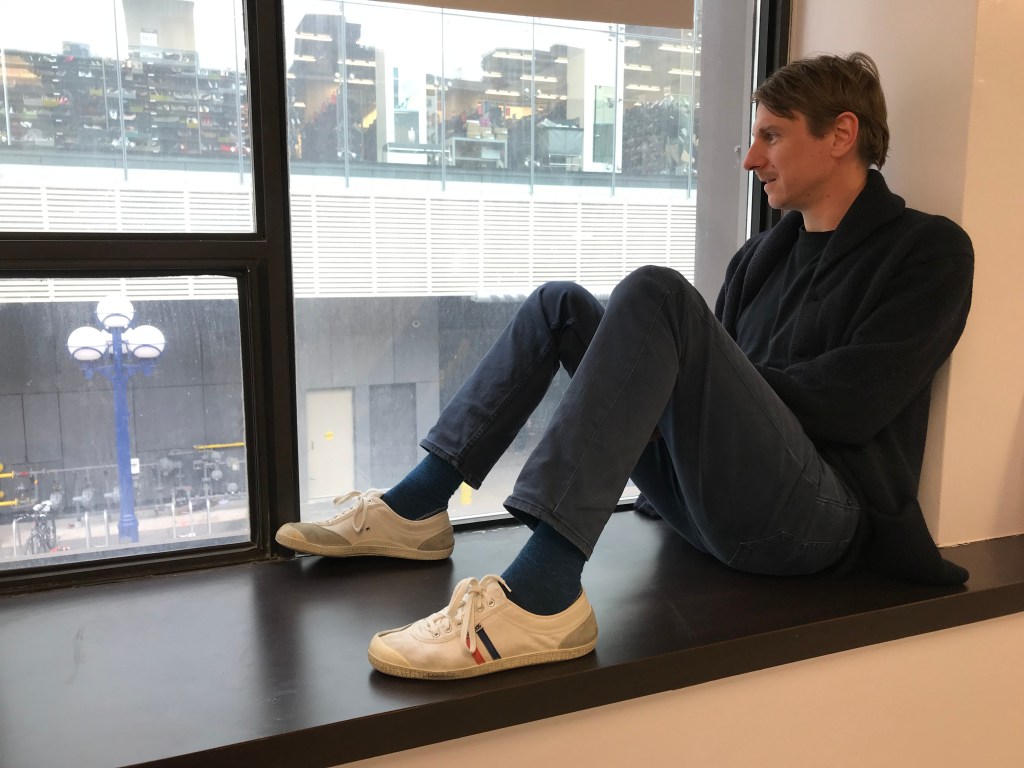
When Paul greets me outside his North York condo building, the first thing I notice is his height. At 6’4” tall, Paul is a giant of a man, with biceps and pectorals that strain the fine knit of his sweater.
“I warn you, my apartment is a bit messy,” he says. Then he chuckles, and adds, “But I guess with three kids you (Anecdotist) are used to it.”
Paul’s apartment is slightly untidy, but not really messy, although a half-eaten pineapple and an opened tin of condensed milk sit on his kitchen counter, along with the makings of coffee.
He solicitously offers to make me a drink, but I decline because we are in a rush. Paul is a part-time personal trainer and needs to meet clients in a little over an hour. Still, I learn very quickly that while exercise is important to him, the body is secondary to the mind in Paul’s world.
“I have a science degree, which is weird because I ended up going into journalism, but I wanted to be a science journalist. And I was one for a long time. And that was really amazing.”
However, he says, in the past five or six years, journalism has “really imploded” and work is sporadic, so he does what he needs to do to earn extra cash. Hence, the personal training.
“I am working on a podcast, but that’s like a multi-hour a week commitment. And it is hard to balance that when, you know, there’s absolutely no guarantee of return.”
Paul says it’s unfortunate that the quality and breadth of journalism is deteriorating so rapidly, given there has never been a greater need for fact-based, unbiased reportage.
“In the last three to four years the amount of pseudo-scientific garbage that is pumped out onto every social media channel is just astonishing. And I’m not just talking about dodgy stuff, like I’m talking about things that actually can harm our society, like anti-vaxxers, for example.”
Paul calls the spread of misinformation very concerning.
“The reason they are able to maintain this belief system is because there is always new shit coming out that supports whatever their viewpoint is. So if you’re, you know, vulnerable and you’re hearing all of this fucking garbage constantly, it’s going to make total sense to you.”
Paul has a Bachelors of Science from the University of Toronto, where he was also the editor of the Varsity, the University’s official student newspaper since 1880.
In his last year, a friend went to London, England, to study art at Goldsmiths University. Her experiences piqued the fledgling journalist’s curiosity.
“I thought the school was really cool because it was a visual art school, mainly. And so they’re always crazy artists running around, you know, crazy sculptors running around and they’re getting drunk and having a good time.”
Paul was intrigued enough that he headed overseas to Goldsmiths himself for his Masters Degree in Journalism. While he was there, Paul did internships at several prestigious newspapers, like The Guardian.
“I really liked it because it was quite theoretical. But I really didn’t like living in England, I found it very stuffy.”
And then, by chance, Paul spotted something else that captured his interest, something that would take him even farther from home. It was an ad for a new TV station being launched in Russia. He applied for a position. Six weeks later he was offered a job that paid $60,000 US, a princely sum for a new graduate in 2005.
“It was a shitload of money, and I had student loans I had to pay, so I was like, ‘Yeah!’”
Paul says it took about three months to complete all the paperwork.
“And then, one day, I packed all my stuff up and my friend drove me to the airport, and I was in Moscow.”
Paul didn’t speak the language, and had just mastered the alphabet when he touched down on Russian soil.
“My first night, I took the Metro, which is amazing, to Red Square. And I remember I was standing there and you know, St. Basil’s Cathedral is there and it’s just like, ‘Holy shit. What am I doing?’ I’ve just done this sort of on a whim, and like, this is actually real now. I’m here.”
Paul worked for “Russia Today” for three years. While he calls it a “full-fledged Kremlin propaganda channel” now, he says 14 years ago the station was just launching, and its producers “really didn’t know what they were doing.”
“They were still building the studio while they were trying to launch the channel. So we would sit there and write copy and then hand it over to somebody who was literally in a closet that they had put a green curtain in. I saw them building this thing from the ground up and it was fascinating.”
Because the station was so new, it also meant a lot of opportunity. Within months, Paul ended up hosting his own science program.
“One day I just pitched them and was like, ‘Listen, why don’t you do a show about science and technology in Russia?’ And they were like, ‘Okay.’ And literally, the next day I had my own show.”
He says while doing the show came naturally and it was one of the “best things” he’s ever done in his life, Paul says he eventually came to believe he couldn’t stay in Russia.
“I’m gay. And it’s not a tolerant culture. And I was harassed. And I had to make a decision.”
Paul says had he been straight he probably would have stayed in Moscow a few more years. However, one horrifying experience with his boyfriend cemented his decision to leave.
“We were going to a gay club, and we were arrested by a cop with a machine gun. They pushed us into the car, and they drove around and threatened to throw us in jail. They scared the shit out of us because they were driving around, we didn’t know where we were, we were entirely at their mercy. There was a guy in the back with us with a Kalashnikov, you know? And we were terrified.”
He says while he tried to brush off the experience, it soured him on the country.
“I just sort of thought, you know, ‘Canada’s a nice place. I have the experience. Now I don’t need to do this.’”
So Paul came back to Toronto, and quickly got a job working for a national broadcaster.
“I read the news on the hour on radio One.”
He worked there for two years, but then he lost his job.
“My mental health really wasn’t that good, because I had lived abroad and I wasn’t getting the treatment that I needed. And I sort of felt a little bit entitled. I was like, ‘I want to be doing science stuff, because that’s what I do.’ And I would pressure them a lot. And you know, I would come in late, and I think they just got tired of me.”
He cites that as one of his biggest regrets.
“They were just, like, ‘Leave,’” he says. “If I had been more professional, and I’d stuck with it, you know, I’d probably still be doing that. Or something similar.”
Paul is candid about his struggles with mental health. He takes four different medications for clinical depression and anxiety disorder, which he has struggled with since he was in his early twenties.
“When I was at my most depressed, I was nonfunctional. I couldn’t get out of bed. The anxiety was bad enough that I would have trouble breathing. I was completely inert.”
However, he says four years ago he started a treatment that literally saved his life.
“It was like a switch was flipped.”
He says rTMS — or repetitive transcranial magnetic stimulation — uses magnets to target and stimulate certain areas of the brain in patients with depression and anxiety.
“They put this magnet next to your head. It’s an electromagnet, it looks like a fat ping-pong paddle and it’s got wires coming out of it,” he says.
“So basically what’s happening is it’s firing pulses of magnetic energy into your brain. And that either inhibits or activates certain nerve cells.”
He says the treatment takes ten minutes a day, with the typical course being 30 days. The treatment works for about a year before he needs to do a “tune-up” or preventative cycle.
“It’s been life-altering. I’m like an evangelist about it.”
Paul says the fact he developed mental illness isn’t surprising, given “that sort of thing typically runs in families.”
He says he recently found out his father was schizophrenic.
“My dad, unfortunately, was quite mentally ill, and that manifests itself in a number of different ways. He wasn’t violent toward me. He was occasionally violent toward my mother, which is what precipitated their divorce. That happened when I was five.”
Paul had very little contact with his father growing up, and didn’t see him again until he was sixteen.
“I suddenly had a desire to see him, so there was a reunion arranged. It was really weird. He wanted me to keep seeing him. I did keep seeing him, you know, over a period of years, but more out of a sense of obligation than anything else, because he still didn’t seem particularly interested in what I was saying or doing.”
Still, despite a strained relationship with his father, Paul says his mother, a school psychologist, did a “fantastic job” raising him.
“It was, I think, what a childhood should be. You know? Lots of opportunity to explore and play and all that sort of stuff.”
He says, however, despite the fact his mother was able to help so many people, she couldn’t help his father.
“And I think she feels badly about that to some extent. But I also think, you know, there’s not much she can do. Schizophrenia is pretty tough to try to crack.”
Paul speaks of his mother with respect and affection, saying he learned so many important life skills from her.
“A lot of people, as I’m sure you know, really have poor skills when it comes to communicating how they’re feeling and stuff like that. So it’s a good thing to have. And as a journalist, you know, it’s been a good skill, to sort of build empathy. Because that really helps you connect with other people, and then they tell you things.”
After losing his job with the national broadcaster, Paul held another job at a competing network for five years. He was unhappy there, and also found out he was being underpaid for the work he was doing. When he complained, however, he says he was fired.
Since then, he has been freelancing.
“It’s horrible. It’s really horrible,” he says. “It sounds maybe a little indulgent, but like, I’m a 41-year-old with two degrees plus international experience at some of the world’s pre-eminent newspapers. I would imagine it’s reasonable to make a salary that’s better than what I was doing ten years ago. You know what I mean? But that’s just not the reality of it anymore.”
He says, if not for his partner of nine years, it would be hard to keep going.
“Honestly, I want to make some money. Because, you know, I’m 41. If I want to have a ‘gaby’, ideally I need some coin, right?”
I ask him what a gaby is.
“Gay baby. Gay dad baby,” he says with a chuckle.
Paul’s partner is 35. He sees a long-term future with him. That, and a desire for a child, are motivating Paul to become more aggressive about making money. What that means is abandoning journalism, and doing more work as a public relations consultant for small companies.
“Which is a bit of a shame because it’s antithetical to how I was educated, but it’s a transition I need to make.”
Still, Paul claims he is happy, although he qualifies that by saying, “I think that I’m less happy than I could be, because being under constant financial stress is always going to impact your happiness level.”

 A Life Beneath